Virtuo Turing — Computer Vision Assessment
A functional assessment engine, running as a camera kiosk
No cloud • No internet • Measurable metrics • Standardised workflow
Aequus is a local-first computer-vision system that captures posture and movement and produces a standardised functional assessment. It estimates the body pose in real time, computes measurable metrics, validates fixed tasks (poses) via transparent heuristics, and generates a session report with an audit trail.
- Fully local runtime: designed to run without internet; no cloud dependency.
- 33 body landmarks: pose estimation with filtering and normalisation for stability.
- Measurable outputs: angles, symmetries, stability proxies, and task-specific rule checks.
- Clinical workflow: operator + subject sessions (S1–S7), per-step performance, and reporting.
- Auditability: JSONL event trail (per frame / per step) plus DOCX export.
Free licence (commercial use allowed)
Aequus is free to use, including for commercial applications. You may redistribute it for free, as long as you do not resell it and you do not modify it. This includes:
Aequus is free to use, including for commercial applications. You may redistribute it for free, as long as you do not resell it and you do not modify it. This includes:
- No changes to the design, UI, branding, or user-facing assets.
- No removal or alteration of Virtuo Turing references.
- No repackaging for sale, paid bundles, or “value-added resales”.
Aequus is intended for professional use (clinics, physiotherapy, sports, and related fields). It is not designed
for consumer self-diagnosis; it records and standardises tasks and metrics. Humans remain responsible for decisions.
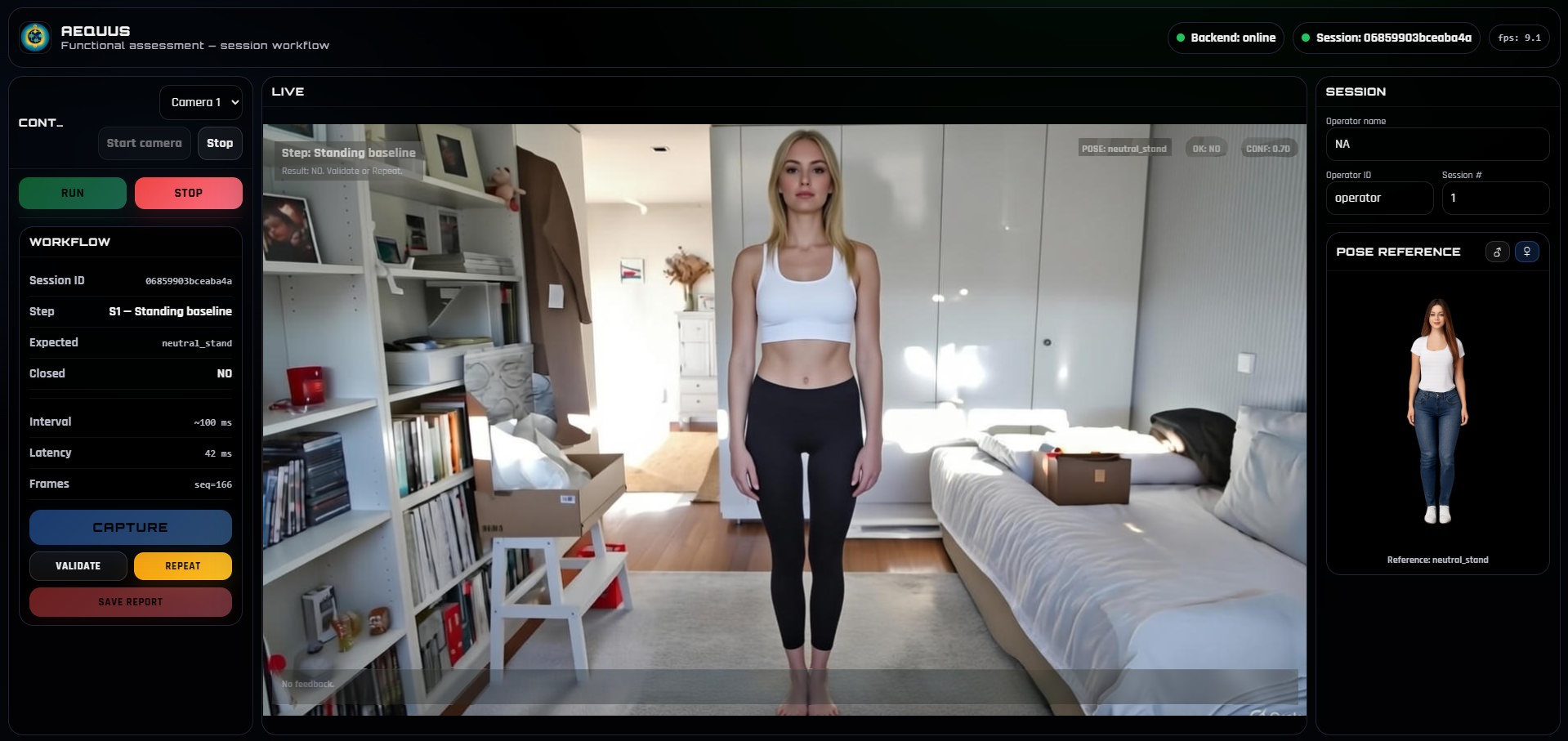 Interface preview
What it does
Pose capture • Metrics • Heuristic validation • HOLD logic
1) Captures posture and movement (local-only)
- Estimates 33 body landmarks in real time and applies filtering/smoothing.
- Normalises pose geometry to reduce scale/position variance (within practical limits).
- Runs entirely on-device: no cloud, no internet requirement, lower latency and better privacy posture.
2) Computes measurable metrics
- Joint angles: shoulders, elbows, hips, knees.
- Symmetry: left/right deltas (shoulders, hips, knees, ankles).
- Valgus proxy: knee–foot relationship (front-facing assumption; heuristically bounded).
- Trunk stability: drift/tremor proxy over a temporal window.
3) Validates fixed tasks (poses) using transparent rules
- Fixed set of tasks, e.g. neutral stand, chair squat (isometric), hinge, lunge split, plank, side plank, bridge, etc.
- Per-task rules output:
- OK + confidence
- Issues list (e.g., uneven shoulders, valgus tendency, pelvis drop, trunk instability)
- HOLD logic: when OK, instructs the user to hold for X seconds and handles cooldowns.
Short translation: a local kiosk camera for standardised functional assessment, producing a report plus an audit trail.
Clinical workflow & reporting
Sessions • S1–S7 steps • DOCX export • JSONL audit
Session-driven workflow
- Creates a session with operator, subject, and session number.
- Runs a structured workflow (S1…S7) for repeatable tasks.
- During HOLD, counts OK frames / total frames and aggregates step-level metrics.
- At each step, computes averages for angles/symmetry/stability proxies (as configured).
Outputs
- DOCX report: session summary, per-step results, and selected metrics.
- Audit JSONL: one line per event/frame/step, suitable for traceability and internal QA.
- Designed for consistency: less “I think it looked better” and more “here is what was recorded”.
Use cases
Clinics • Sports medicine • Insurers/TPAs • Occupational programmes
A) Clinics (realistic uses)
- Physiotherapy / rehabilitation: baseline capture on simple tasks (isometric squat, hinge, lunge, plank).
- Progress tracking: compare OK ratios, symmetry deltas, and mean angles across sessions.
- Quick triage: flag gross asymmetries, poor lumbopelvic control proxies, valgus tendency signals.
- Standardisation: reduces variability between operators (does not eliminate judgement).
B) Orthopaedics / sports medicine
- Pre/post intervention snapshots (e.g., post-ACL), using simple, repeatable tasks.
- Operational evidence rather than patient memory and vibes.
- Critical point: heuristics help record and compare; they are not a diagnosis engine.
C) Insurers / claims management (where it fits)
- Claims rehab tracking: standardised evidence of functional evolution over time.
- Referral escalation: identify cases not progressing and trigger clinical re-evaluation (by humans).
- Return-to-work programmes: simple task-based assessments in occupational settings (with explicit consent and clear purpose).
- Provider networks: harmonised reporting across partner clinics (DOCX + audit trail).
About “fraud detection”
- Yes, it is technically tempting. No, it is not a clean idea.
- Results depend on camera setup and visibility; rules are not a clinically validated device.
- If an insurer wants this seriously: human decision-maker, metrics as evidence only, auditability (already supported), and GDPR discipline (consent, minimisation, retention limits).
Limits, positioning, and compliance notes
Free distribution • No resale • No modification • Not diagnostic
Hard constraints (do not pretend otherwise)
- Not a clinically validated model: it is a ruleset that can be tuned internally.
- Front-facing assumptions affect some heuristics (e.g., valgus proxy).
- Measurement is not ground truth: angles and symmetry deltas are computed from 2D/3D pose estimates, not from instrumented biomechanics. Treat them as operational proxies.
- Occlusion and self-occlusion: crossed arms, hands on hips, loose clothes, long hair, chairs/rails, and people walking behind the subject can break tracking or bias landmarks.
- Camera geometry matters: lens distortion, camera height, tilt, distance, and field-of-view change apparent joint angles and can shift knee–foot relationships.
- Body diversity: limb proportions, mobility limits, pain avoidance patterns, and assistive devices can make a “rule-perfect” pose unrealistic or unsafe for a given person.
Regulatory / narrative guardrails
- Free for commercial use, with strict limits: no resale, no modification, no UI/design/branding changes, and no removal of Virtuo Turing references.
- Not clinical decision support and not diagnostic: it provides metrics and structured recording, not medical conclusions.
- Positioned as wellness/fitness/training and progress reporting, risk is lower. Clinics and insurers will try to pull it into “clinical” territory anyway—marketing must not do that for them.
- As presented, it is not a medical device software under MDR because it is not intended for diagnosis, prevention, monitoring, prediction, prognosis, treatment, or alleviation of disease by software output. If you change the claims, you change the obligations.
Operational rule: keep humans in the loop, keep retention short, keep consent explicit, keep the audit trail intact.